


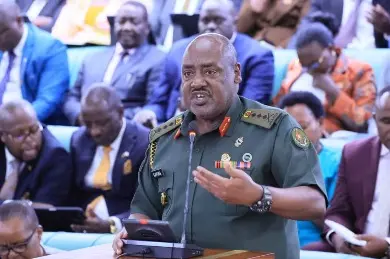
Lt Gen Sam Kavuma, the Force Commander of the African Union Support and Stabilisation Mission in Somalia (AUSSOM), has urged MPs to emulate President Museveni’s practical leadership and implement government policies in their constituencies.
Kavuma made the call during a parliamentary debate on a motion thanking Museveni for outlining government policy in the State of the Nation Address delivered on June 4, 2026.
The debate will run for four weeks.
Kavuma reflected on Museveni’s resourcefulness as a young man in 1968. He said Museveni used the limited resources available to him to support communities.
Kavuma said his family benefited from that leadership.
“My parents moved from Kazo to Buwekula in Mubende, to Bulemeezi in Ngoma. That’s where I was born 64 years ago. The family again moved to Gomba, Ssembabule, back to Ankole. That’s where he met them, my parents, in 1968,” Kavuma recounted.
He said Museveni also demonstrated leadership by reviving Uganda’s economy after taking power in 1986.
“Out of the Shs84 trillion you did pass in this House, the economy of Uganda funded about half of it, maybe Shs44 trillion. But in 1986, the whole country was collecting only Shs5 billion. That is the country that the President took over, where all essential commodities were being obtained from outside. No roads, no infrastructure,” Kavuma said.
Kavuma urged MPs to draw lessons from the State of the Nation Address instead of only praising the President.
“What do we learn from this State of the Nation Address? Is it enough for us to stand here and appreciate him? I think we need to learn something from him: that leadership is not about positions, generals, honourable members or ministers. Leadership is not even about having a lot of resources. Leadership is about commitment and being pragmatic, so that you use whatever you have to move your people from one stage to another,” he submitted.
During Parliament’s 10th sitting, Kavuma also responded to a statement by Health Minister Dr Chris Baryomunsi on severe malaria cases affecting children.
He said many Ugandans suffer or die from malaria and other illnesses because they avoid medical check-ups and rely on self-medication.
“About 98 per cent of Ugandans do not go for periodic and regular medical check-ups. We live on self-medication. Most of us have mini pharmacies in our bedrooms and houses,” Kavuma submitted.
He also raised concern about poor diagnosis in some laboratories and hospitals. He said this could lead health workers to treat the wrong illnesses.
“Even the two per cent who try to check regularly do not get the right diagnosis. Where is the problem?” he asked.
Kavuma urged MPs to sensitise people in their constituencies about the need to seek medical check-ups before taking medicine.
He also asked the ministries of Education and Health to establish the cause of malaria cases in schools and develop an appropriate response.
The Deputy Speaker of Parliament, Thomas Tayebwa, chaired the sitting.


, has urged MPs to emulate President Museveni’s practical leadership and implement government policies in their constituencies.)