


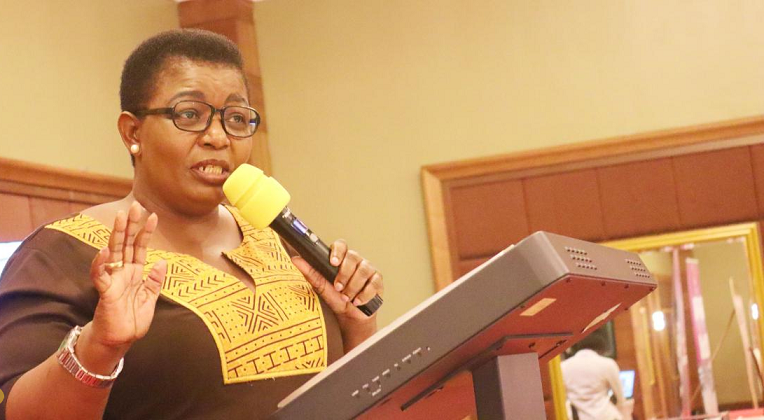
Former Kira Municipality MP Ibrahim Ssemujju Nganda has thrown Parliament into fresh controversy after questioning President Yoweri Museveni’s appointment of Justine Kasule Lumumba as Government Chief Whip despite her not being a Member of Parliament.
The fiery opposition politician described Lumumba as a “Stranger” in parliamentary terms and warned that the controversial appointment could be an attempt to legitimise what he called long-standing irregularities surrounding the powerful office.
Under parliamentary language, any person physically inside the precincts of Parliament who is not an MP is referred to as a Stranger.
Lumumba, who served in the last term as Minister of State for General Duties in the Office of the Prime Minister, was among the fresh appointees announced by President Museveni on Tuesday evening.
However, unlike all previous Government Chief Whips since Uganda returned to multiparty politics in 2006, Lumumba is currently not a sitting MP.
Her appointment has now triggered legal and procedural questions over whether the move violates parliamentary laws and rules.
Section 6 of the Administration of Parliament Act and Rule 15 of Parliament’s Rules of Procedure clearly state that the Government Chief Whip should be appointed “from among Members of Parliament representing the ruling party.”
Speaking in an interview, Ssemujju blasted the appointment and argued that Museveni was now cementing confusion that has existed around the office for years.
“Ordinarily, the whip, whether chief or ordinary party whip, should be a member of parliament, and it has never happened with an outsider,” Ssemujju said.
Since 2006, every Government Chief Whip has been a serving MP.
Those who have held the position include Kabakumba Masiko, who became the first appointee and also doubled as Minister for Parliamentary Affairs, Daudi Migereko from 2009 to 2011, Justine Kasule Lumumba herself from 2011 to 2014, Ruth Nankabirwa Sentamu from 2015 to 2021, Thomas Tayebwa from 2021 to 2022, and Denis Hamson Obua from 2022 to 2026.
Ssemujju argued that although the law envisages the Chief Whip as a parliamentary role held by a ruling party MP, Museveni gradually transformed the office into what is effectively a full cabinet ministerial position.
According to the former Opposition Chief Whip, Parliament already budgets for the Government Chief Whip and even provides offices for the holder of the position, just like it does for the Opposition Chief Whip.
However, he said the same office holder is again facilitated under the Office of the Prime Minister as a cabinet minister, creating duplication and what he called an irregular “dual role.”
“You can’t have a person provided for by parliament and is also provided by the executive,” Ssemujju stated. “It is irregular. But that’s what Museveni has done and he has given that office a dual role.”
He further argued that the original duties of the Chief Whip have now been distorted.
According to Ssemujju, the real work of the Government Chief Whip is mobilising MPs to attend parliamentary sessions, ensuring participation and voting, and handling party business in the House.
He insisted that the role was never meant to command ministers or perform cabinet-level executive duties.
“The government whip should not be the one commanding ministers. That is not his duty. That’s the duty of the leaders of government business and their deputy,” Ssemujju said.
“This is supposed to be a full-time parliamentary job, but now the person is also a full cabinet minister. So that confusion now, I think he has cemented it by bringing someone who is not an MP.”
Ssemujju then compared Lumumba’s appointment to previous controversial decisions by Museveni, including appointing serving military officers into cabinet positions.
He recalled how Parliament and former Speaker Rebecca Kadaga initially resisted the appointment of Gen Jeje Odongo but later similar appointments became normalized.
“When Museveni appointed Jeje Odong… Parliament and Kadaga refused to vet him… But subsequently Museveni appointed others who were not challenged and it became normal,” Ssemujju said.
“So he has returned on this position and this is now an attempt to normalise an abnormality.”
The appointment has now revived old debates inside Parliament over whether the office of Government Chief Whip has gradually expanded beyond its original mandate and taken on executive powers it was never intended to hold.
The controversy is not entirely new.
Back in 2016, the role of then Government Chief Whip Ruth Nankabirwa came under sharp scrutiny during plenary sittings after legislators questioned why she was increasingly sitting in for ministers and responding to matters that ordinarily belonged to substantive ministers or the Leader of Government Business.
At the time, Ssemujju, then serving as Opposition Chief Whip, openly challenged Nankabirwa’s expanding authority inside government.
Former UPC Parliamentary Whip and Apac Woman MP Santa Alum also questioned what she described as the growing executive powers of the Government Chief Whip.
Meanwhile, despite the legal and procedural storm now surrounding her appointment, congratulatory messages for Lumumba have continued flooding social media.
About 17 hours after the cabinet list was released, Lumumba took to X, formerly Twitter, and publicly embraced the controversial appointment.
“I am humbled by this responsibility as Government Chief Whip and commit to serve diligently in coordinating government business in Parliament for the good of all Ugandans,” she posted.


