


By Investigative Desk
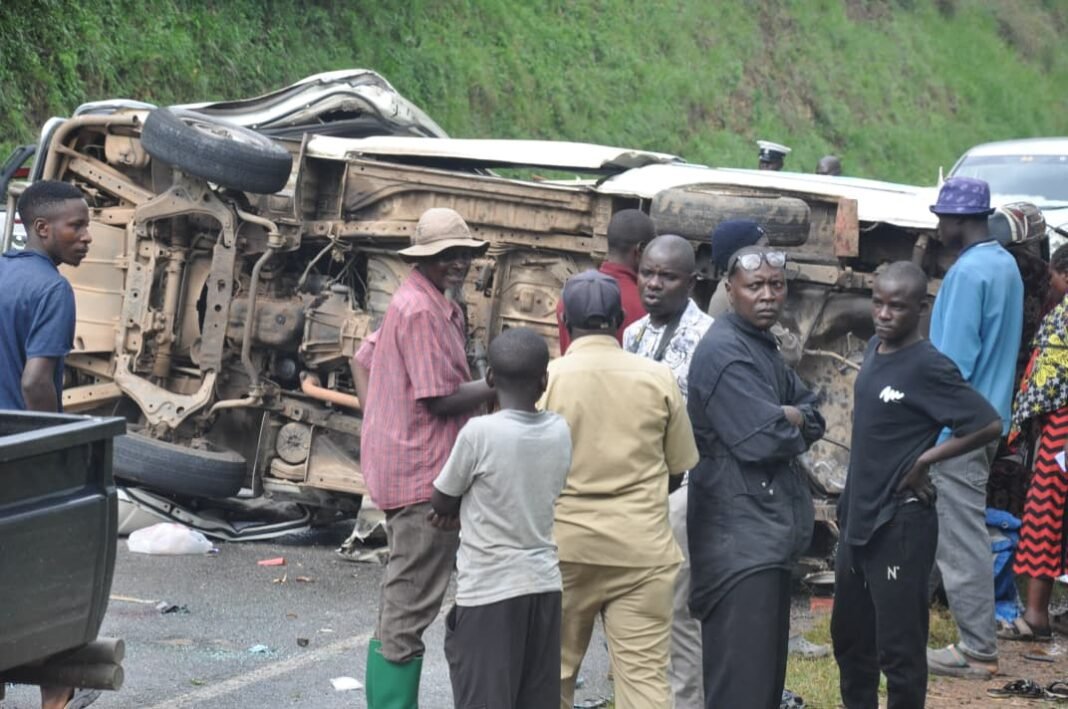
Sunday’s fatal crash on the Mbarara–Bushenyi Road—which left one person dead and several others critically injured—has reignited scrutiny over a troubling reality: some roads are not just busy—they are predictably dangerous.
The collision between a passenger taxi (UBE 047S) and a heavy truck traveling from Mbarara is the latest in a string of serious accidents along this key western Uganda corridor linking to Bushenyi.
A Known Blackspot
To frequent users, the road’s risks are no surprise.
“There are sections where overtaking is blind, but drivers still take chances,” said Mr. Moses Rwengye, a regular commuter on the route.
“You can drive carefully, but another driver’s mistake can kill you,” he added.
Transport observers say several stretches of the highway combine high speed, heavy traffic, and limited visibility, creating conditions where small errors quickly turn fatal.
Road Design Under Question
While human error is often blamed, engineers argue that road design plays a critical role in accident frequency.
“If a road allows high speeds but lacks proper shoulders, markings, and overtaking lanes, it becomes inherently risky,” said Eng. David Tusingwire, a transport infrastructure specialist.
Some sections of the Mbarara–Bushenyi Road reportedly suffer from:
Faded or missing road markings
Narrow carriageways
Limited signage in high-risk zones
“Drivers rely on judgment in situations where the road should guide them clearly,” Eng. Tusingwire added.
Enforcement That Comes and Goes
The Uganda Police Force has previously deployed traffic officers on major highways, but road users say enforcement is inconsistent.
“You may find police on one day, then for a week there is no one,” said Ms. Beatrice Nansubuga, a trader who travels frequently between towns.
“When enforcement disappears, bad driving returns immediately.”
Police maintain that operations are ongoing.
“We carry out regular traffic checks and sensitization campaigns to improve compliance,” said ASP Samson Kasasira, police spokesperson.
The Overtaking Gamble
One recurring factor in highway crashes is risky overtaking, particularly involving taxis and trucks.
“Most accidents here happen when drivers try to overtake in unsafe places,” said Mr. Paul Byamukama, a local resident.
Heavy trucks, due to their size and speed, complicate overtaking maneuvers—especially on narrow stretches.
“Once a truck is involved, the damage is usually severe,” he added.
Community Living With Fear
For communities along the highway, crashes are not distant news—they are part of daily life.
“We hear brakes screeching and crashes often. Sometimes you even fear standing near the road,” said Ms. Prossy Kyomuhangi, a roadside vendor.
Residents say they are often the first to respond, turning homes and shops into temporary rescue points.
Data Without Action?
Road safety advocates argue that Uganda has enough data to identify dangerous corridors—but implementation lags behind.
“We know where accidents happen frequently. The issue is acting on that information consistently,” said Mr. Stephen Rwomushana, a road safety activist.
Suggested interventions include:
Installing speed calming measures in high-risk zones
Improving road signage and markings
Creating designated overtaking lanes
Increasing permanent enforcement presence
A Predictable Tragedy
As investigations into Sunday’s crash continue, many observers say the incident fits a familiar pattern.
“When you look at the conditions—speed, road design, enforcement gaps—the outcome becomes predictable,” Eng. Tusingwire noted.
The Cost of Inaction
For victims and their families, the consequences are immediate and devastating. But for policymakers, the challenge is longer-term: whether repeated warnings will finally lead to change.
“We don’t need to wait for another crash to act. The danger is already clear,” said Mr. Rwomushana.
Until meaningful improvements are made, the Mbarara–Bushenyi Road risks remaining not just a vital transport link—but a corridor of recurring tragedy.


