


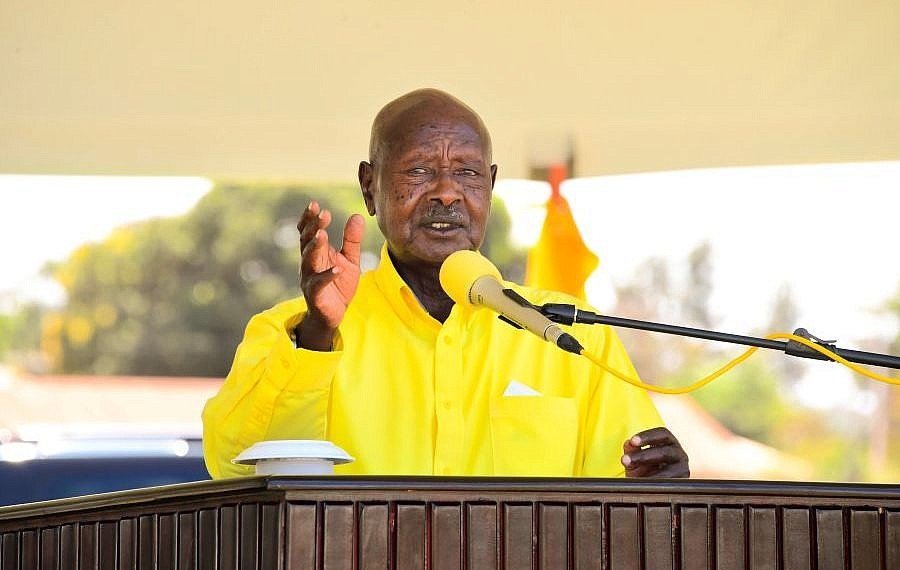
President Museveni, who is also the NRM presidential flag bearer, has pledged to continue improving road infrastructure in the Lango sub-region as part of his 2026 campaign activities.
Addressing more than 15,000 NRM leaders at Lango College in Lira City on Sunday, 7 December 2025, the President acknowledged concerns about regional connectivity and promised to review the issue of the eastern access route to ensure balanced development across Lango.
“I’m going to study the issue of eastern access, the one you talked about. That one makes sense,” he said.
He noted that the current route forces residents of Namasale in Amolatar to make long and unnecessary journeys, adding, “It makes no sense for someone from Namasale in Amolatar to travel all the way through Lira, Kamdini, and Karuma when Nakasongola is just across the water.”
Government Chief Whip Denis Hamson Obua presented a proposal from leaders of Amolatar, Dokolo and Alebtong districts calling for additional road upgrades to support trade, tourism and accessibility.
He asked the President to consider annexing the 42.4-kilometre Dokolo–Bata–Abako–Aloe Road to other ongoing projects, arguing that improved connectivity would strengthen ferry links at Amolatar and Kaberamaido, reduce travel time between sub-regions and enhance access to tourism areas such as Kidepo Valley National Park.
Obua also referenced an Equal Opportunities Commission report indicating that Lango has only 5 per cent tarmac coverage, the lowest in the country.
The meeting, one of the region’s largest mobilisation engagements, gathered NRM leaders from LC1 to the district level as they prepare to rally support for Museveni’s re-election bid and all party flag bearers in 2026.
The President highlighted completed and ongoing projects such as the Soroti–Lira Road, the Rwenkunyu–Masindi Port–Lira–Apac Road and the Bobi–Aboke Road, saying they were achieved through national prioritisation.
He reminded the gathering of the NRM’s key contributions to Uganda’s development—peace and security, infrastructure, wealth creation, expanded education, job creation, markets and regional integration.
Reflecting on Lango’s history of conflict under the Amin regime, subsequent wars, the LRA insurgency and cattle rustling, he cautioned those undermining national stability.
“The people of Lango know what lack of peace means,” he said, recalling individuals he personally knew who were killed under past regimes.
He also recounted his opposition to Idi Amin’s 1971 coup, saying, “At 5 pm on the same day Amin took over, we met as a student movement in Bugoloobi and said we must fight Idi Amin. That night, I left Uganda and joined others in Tanzania.”
The President revealed that the party is considering paying monthly salaries to selected grassroots NRM leaders to strengthen mobilisation ahead of 2026, but warned that salaries alone are not sustainable.
“We shall have to discuss and agree on how many NRM leaders could be paid and why,” he said.
He instead emphasised wealth creation programmes such as Operation Wealth Creation and the Parish Development Model, which now allocates an additional Shs 15 million per parish for local leadership activities.
“The best way is to help families to have their own income to support themselves and the party,” he said, rejecting the idea of forcing poor members to pay subscription fees.
NRM Second National Vice Chairperson Anita Among praised Museveni for restoring peace, recalling the insecurity caused by Kony–Lakwena rebels.
“You would sleep one week on the road because of insecurity,” she said. She also commended the President for increasing LC1 chairperson pay from Shs 10,000 to Shs 100,000 and called for LC1 leaders to be made ex-officio district council members to strengthen oversight of government programmes.
Obua described the gathering as historic, saying no mobilisation meeting of its magnitude had ever been held in Lango.
He highlighted key achievements, including the establishment of Lira University, the upgrade of Lira Hospital to regional referral status, the construction of Akii Bua Stadium and progress on strategic roads such as the Dokolo–Kaberamaido–Namasale and Abuke–Bobi routes.


