


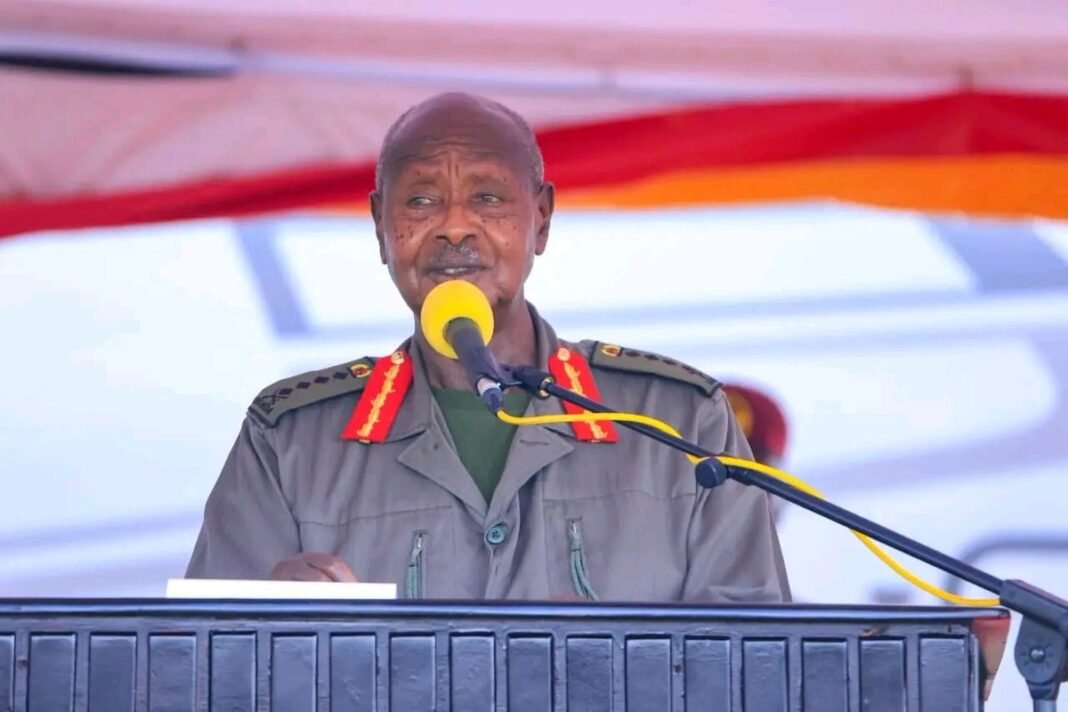
President Museveni has called on leaders across the continent to prioritise Africa’s strategic security, warning that without unity and technological advancement, the continent risks continued vulnerability in a rapidly evolving global order.
Addressing NRM Members of Parliament during the official opening of the party retreat in Kyankwanzi on Wednesday, Museveni framed Africa’s past—from slavery to colonialism—as a lesson in the dangers of disunity and weakness.
“There is another mission of strategic security.Africa was first of all ravaged by slave trade for 400 years… then after that it was colonialism,” Museveni said.
He warned that while other regions lost their indigenous populations entirely, Africa narrowly avoided a similar fate.
“Other people colonised disappeared. If you go to Australia you won’t find the original people—they were decimated. Africa being colonised was very risky… but somehow we survived.”
Museveni said that survival should now translate into a long-term commitment to safeguarding the continent.
“One of the historical missions is never again for Africa to be threatened or marginalised.”
The president criticised post-independence leaders for failing to fully pursue political integration, arguing that economic cooperation alone is insufficient.
“When we got independence, people got relaxed,” he said. “We had to get independence and unite for an African federation. But we forgot about political integration.”
While praising initiatives such as the East African Community and Africa Continental Free Trade Area, Museveni said if well implemented, they will lead to prosperity of Africans.
“They will solve the problem of prosperity if well implemented. They will however not solve the problem of strategic security. How can Africa defend itself against all threats?”
Museveni contrasted Africa’s limited capabilities with global powers, highlighting gaps in defence and technological reach.
“Some countries like the United States operate in four spheres—on land, at sea, in the air and in space—but we are not there,” he said. “We are just on land or sea.”
He pointed to advances in space exploration as a symbol of widening inequality. “As we speak, some satellite of the United States is going around the moon, but for us we are here… This is very dangerous.”
In a pointed remark, he added: “We want to go to the moon to ask, ‘What are you doing there?’ The moon is a common property, but we are here dancing while other people are up there looking at us.”
Regional security gaps
Museveni also raised concerns about Africa’s inability to secure its own territory, citing weak military infrastructure.
“How can Uganda have a navy? We are not even near the water,” he said. “Those who are near the water don’t have a navy.”
He argued that only regional integration can address such gaps. “That’s why we need the political federation of East Africa for strategic security.”
The president linked security to economic strength, outlining the National Resistance Movement’s ideological framework.
“Our first problem was lack of prosperity,” he said. “Our people were not living a prosperous life—bad houses, poor health, not enough nutrition.”
He emphasised productivity over dependency. “You can’t get prosperity through begging or corruption but through work. Every adult Ugandan must produce a good or service.”
However, he noted that local production requires broader markets. “If you emphasise tribes or religion, some people don’t buy your products,” he said. “That’s how we developed the principle of patriotism.”
He added that regional and continental markets are essential: “Our next prescription for prosperity was Pan-Africanism.”
Museveni also urged leaders to protect African heritage and cultural systems.
“African heritage is very strong. Our culture is very strong,” he said. “We need to guard our heritage. We need to protect our languages and feed Kiswahili with more vocabulary.”
He cited his own lifestyle choices as an example of self-reliance.
“I eat cassava, bananas, millet… When there was war in Ukraine, people said we were going to starve, but I said no. Unless Karuma was cut off and Cassava couldnt come from Northern Uganda but I didn’t fear. ”
The president told MPs they must go beyond political support and deeply understand the movement’s guiding principles.
“You are now not only followers of the NRM but also leaders,” he said. “There is a difference between a follower and a leader.”
Drawing a religious analogy, he added: “You are therefore now priests of NRM… It is important you consolidate whatever you already know.”
He outlined three pillars—ideology, philosophy and strategy—as essential for leadership.
“A political leader must carry out diagnosis of the people… After that you design the prescription.”
Museveni warned that global conflicts should serve as a wake-up call for Africa.
“What is happening should wake up Africans to unite and be strong. People like to be big fish in small ponds, but when real challenges come, you don’t have enough.”
He stressed that the current generation has a responsibility to transform the continent.
“This generation must create prosperity for African people… and ensure Africa is secure.”
Source BY NILE POST


