


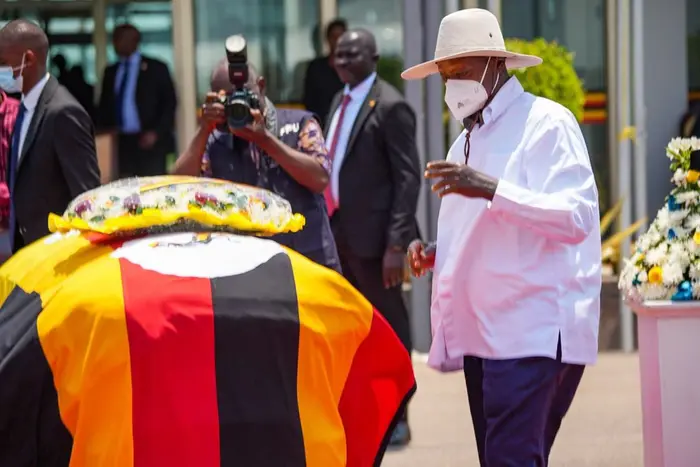
President Yoweri Museveni has called for a peaceful and lawful resolution to the dispute over the succession of the late Omukama of Tooro, King Oyo Nyimba Kabamba Iguru Rukidi IV.
Museveni said the government was ready to work with the next Tooro king once the succession question had been settled, but stopped short of endorsing the recent declaration of Prince Edward Rukidi Kijanangoma as the new monarch.
The President’s message was delivered by Deputy Speaker of Parliament Thomas Tayebwa during the burial service for King Oyo at St John’s Cathedral in Fort Portal on Saturday.
Museveni urged the Batooro to avoid divisions and use legal and peaceful means to resolve the disagreement over who should succeed the late king.
“When the issue of the new king of Batooro is resolved, we shall be happy to work with the new king as we did with His Highness Oyo,” Museveni said.
He added: “I appeal to the Batooro to use peaceful and legal means to resolve this matter and also look for maximum unity instead of division.”
The President’s remarks come days after Prince Charles Akiiki Kamurasi, the Musuuga and head of the Babiito Clan, announced Prince Edward Rukidi Kijanangoma as King Oyo’s successor.
Kamurasi made the declaration during the late king’s final send-off, saying the selection had been carried out by princes and princesses under his leadership in accordance with Ugandan law, Tooro customs and traditions.
However, the declaration has been rejected by members of King Oyo’s immediate family.
Princess Ruth Komuntale, the late king’s sister, has maintained that Oyo left a will naming his biological son as the heir to the Tooro throne.
Princess Elizabeth Bagaya, Oyo’s paternal aunt, and Margaret Komubaizi, the assistant Batebe of Tooro, have also backed the family’s position. They argue that consultations on the late king’s will had not been concluded when the new king was announced.
Museveni on King Oyo’s legacy
In his message, Museveni described King Oyo as a cultural leader who maintained a cordial relationship with the central government by concentrating on cultural affairs and mobilising his subjects for development.
“He was a good leader of culture that never clashed with the central government because he remained in his lane of culture and mobilising people for development,” Museveni said.
He described Oyo’s death as a major loss and extended his condolences to the people of Tooro.
Museveni also used the occasion to clarify the role of traditional leaders in Uganda, saying cultural institutions were restored in 1993 primarily to preserve Uganda’s cultures, languages and customs.
“The cultural leaders restored in 1993 are not for politics, administration or legislation. He or she is for culture which includes language and customs,” he said.
According to Museveni, traditional leaders have a responsibility to protect indigenous languages and cultural practices that are increasingly threatened by modern lifestyles.
He cited the preservation of languages and customs, as well as encouraging communities to maintain their cultural identity, as some of the key responsibilities of traditional institutions.
Museveni further said cultural leaders can contribute to economic development by promoting initiatives that help their communities create wealth.


