


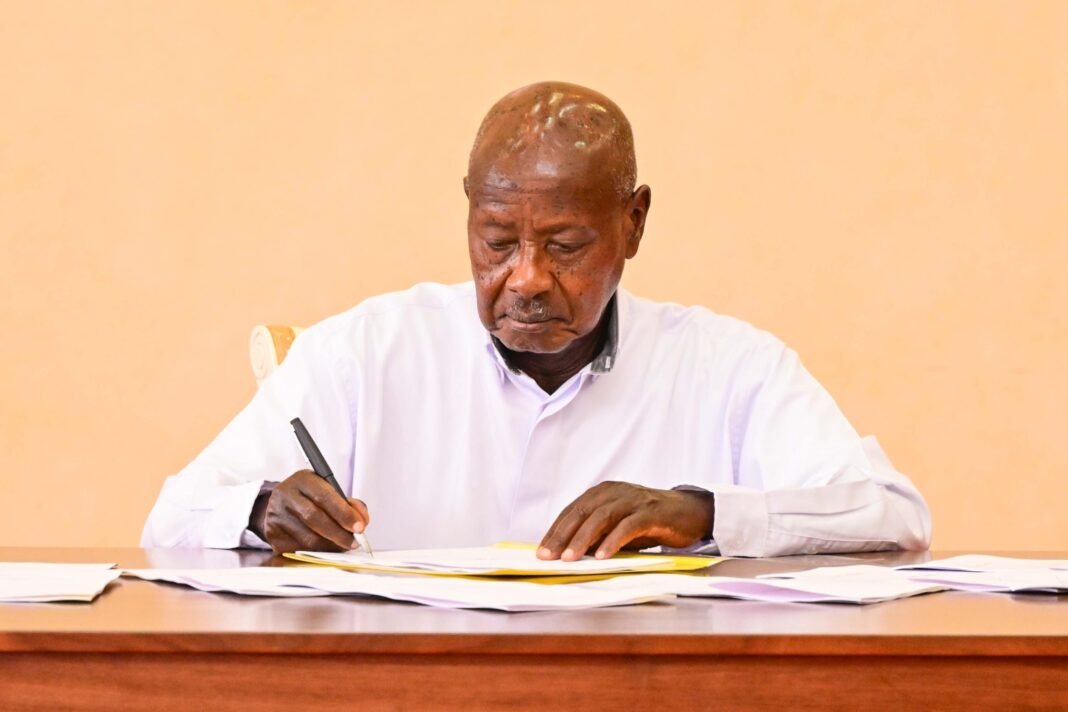
President Yoweri Museveni has moved to distance himself from a circulating draft of the proposed Sovereignty Bill, saying it diverges from the original intent of his initiative and risks creating unnecessary public anxiety.
In a strongly worded clarification, Museveni emphasized that the bill was conceived specifically to safeguard Uganda’s independence in policy decision-making, not to regulate or interfere with private economic activity or religious practices.
“I have talked to Hon. Hamson Obua and the Chairpersons of the relevant Parliamentary Committees to make the Bill concentrate on the sovereignty of policy-decision-making,” Museveni said. “It should not meander into areas of the freedom of private enterprise transfers, private money transfers, or church donations.”
Narrowing the Legislative Focus
The President’s remarks signal a deliberate attempt to narrow the scope of the bill at a time when debate around its provisions has intensified. Early discussions and interpretations of the proposed legislation had sparked concern among sections of the public, private sector players, and civil society groups, who feared it could introduce sweeping controls over financial transactions and institutional autonomy.
By drawing a clear line, Museveni appears keen to reassure both domestic and international stakeholders that Uganda remains committed to protecting economic freedoms while asserting its right to independent governance.
Political analysts say the clarification is significant, as it sets boundaries for lawmakers currently engaged in shaping the bill through parliamentary processes. It also indicates that State House is closely monitoring how the proposal is being interpreted and developed at committee level.
Engagement with Parliament
Museveni’s direct engagement with the Government Chief Whip and parliamentary committee leaders underscores the importance his administration places on the legislation. Hamson Obua, who plays a central role in coordinating government business in Parliament, is expected to guide ruling party legislators in aligning the bill with the President’s directive.
Parliamentary committees tasked with reviewing the draft are now likely to revisit certain clauses to ensure they reflect a narrower and more precise mandate. Insiders suggest that revisions could be introduced to eliminate ambiguities that might have allowed broader interpretations affecting financial systems or civil liberties.
Public Concerns and Economic Implications
The Sovereignty Bill has generated debate partly because of its timing, as Uganda continues to position itself as an attractive destination for investment while also navigating complex global economic and political dynamics. Any suggestion of restrictions on capital flows or private enterprise can have far-reaching implications for investor confidence.
Business leaders and financial experts had raised concerns that provisions touching on money transfers or private enterprise could disrupt banking operations, remittances, and cross-border trade—key pillars of Uganda’s economy. Similarly, religious institutions expressed unease over any potential oversight of church donations, which are often privately managed.
Museveni’s clarification directly addresses these fears, reinforcing that such areas fall outside the intended scope of the legislation.
Sovereignty in a Global Context
At its core, the proposed bill is understood to be part of a broader policy direction aimed at strengthening Uganda’s autonomy in making national decisions without undue external influence. This aligns with longstanding positions taken by Museveni on issues of self-determination, regional integration, and resistance to foreign pressure in domestic affairs.
Analysts note that while many countries seek to assert policy sovereignty, the challenge often lies in balancing that objective with maintaining openness to global markets and adherence to international norms.
What Comes Next
With the President’s guidance now explicit, attention turns to Parliament, where the bill is expected to undergo further scrutiny and possible redrafting. Lawmakers will need to reconcile earlier proposals with the clarified objective, ensuring the final legislation is both precise and consistent with constitutional protections.
The coming weeks are likely to see intensified consultations among legislators, legal experts, and stakeholders to refine the bill’s language and avoid unintended consequences.
For now, Museveni’s intervention appears aimed at resetting the conversation—shifting it away from fears of economic or social restriction and back toward the central question of how Uganda defines and protects its decision-making sovereignty in an increasingly interconnected world.


