


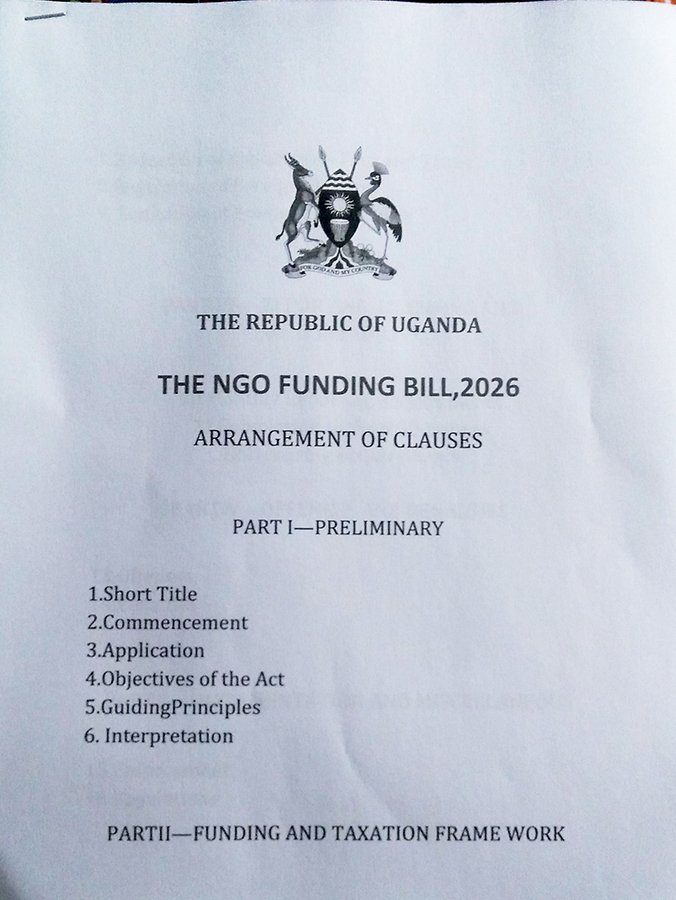
KAMPALA — Ugandan businessman Nyanzi Martin Luther has announced plans to revise his controversial draft NGO Funding Bill following growing criticism from civil society organisations that argued the proposal could threaten the independence of Uganda’s civic sector.
The development comes months after the proposed legislation triggered heated debate among governance activists, legal experts and development organisations over the future of NGO financing and regulation in Uganda.
In a statement shared on his social media handle X (formerly known as Twitter), Nyanzi said the draft proposal would first be amended and renamed before being submitted to Parliament.
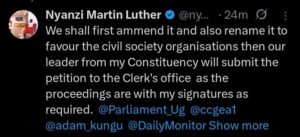
“We shall first amend it and also rename it to favour the civil society organisations, then our leader from my constituency will submit the petition to the Clerk’s office as the proceedings are with my signatures as required,” he wrote.
The proposed bill seeks to establish a National NGO Fund aimed at providing financial support to community-based organisations and non-governmental organisations operating across the country.
Nyanzi has previously argued that many local organisations remain vulnerable because of their heavy dependence on foreign donors whose priorities often change, affecting long-term sustainability.
However, the proposal immediately attracted resistance from sections of the civil society community.
During a stakeholder engagement in Kampala earlier this year, several activists and governance experts warned that government involvement in NGO financing could undermine the sector’s autonomy and weaken its ability to hold public institutions accountable.
Among the most vocal critics was Dr Sarah Bireete, Executive Director of the Centre for Constitutional Governance (CCG), who cautioned that reforms affecting NGOs should emerge from wider consultations with stakeholders.
“If not handled carefully, this bill could limit the operating space for NGOs and CBOs,” Bireete warned, arguing that civil society organisations must remain actively involved in shaping any legislative changes affecting their work.
Lawyer and governance advocate Andrew Karamagi also defended the role of NGOs, describing civil society organisations as a critical part of Uganda’s democratic and social development framework.
“Civil society organizations and NGOs are an indispensable component of the socioeconomic and political fabric of our polity,” Karamagi said during discussions surrounding the proposals.
Civic activist Job Kiija questioned the rationale behind government financing of organisations that often exist to address governance and service delivery gaps left by the State.
“NGOs exist to fill the gaps left by the inefficiencies of government,” Kiija argued, warning that a government-controlled fund could eventually become a mechanism for influence rather than support.
Women’s rights activist Sarah Mukasa similarly raised concerns about what she described as the broader implications of increased state involvement in NGO operations and financing.
“The timing and purpose of the bill suggest it could be used more for control than support,” she said.
The criticism emerged against a backdrop of increasing tensions between government and civil society organisations. In recent years, several NGOs have faced investigations, suspensions and regulatory disputes, developments that activists say have contributed to concerns about shrinking civic space.
Civil society groups have also pointed to previous government actions against NGOs, including the suspension of dozens of organisations in 2021 over alleged compliance irregularities, some of which later challenged the decisions in court.
Despite the backlash, Nyanzi has consistently defended the proposal, insisting that it was intended to strengthen local organisations rather than restrict them. He has argued that Uganda needs a sustainable domestic financing model capable of supporting community initiatives in areas such as health, education, youth empowerment and humanitarian assistance.
The activist also previously maintained that the proposal does not seek to ban foreign funding but instead aims to reduce excessive dependence on external donors while promoting accountability and local ownership.
His latest decision to amend the draft is being interpreted by some observers as an attempt to ease tensions with civil society organisations and build broader support before the proposal reaches Parliament.
Political analysts say the revisions could prove crucial if the proposal is to gain legitimacy among stakeholders who have demanded wider consultation before any changes to Uganda’s NGO financing framework are considered.
Although the petition has not yet been formally tabled before Parliament, debate surrounding the proposal has already expanded into wider discussions about foreign funding, civic freedoms, accountability and the future relationship between government and civil society organisations in Uganda.
Whether the planned amendments will satisfy critics remains uncertain, but Nyanzi’s decision to revisit the proposal marks the clearest sign yet that pressure from civil society actors is beginning to reshape one of the country’s most closely watched governance debates.


