


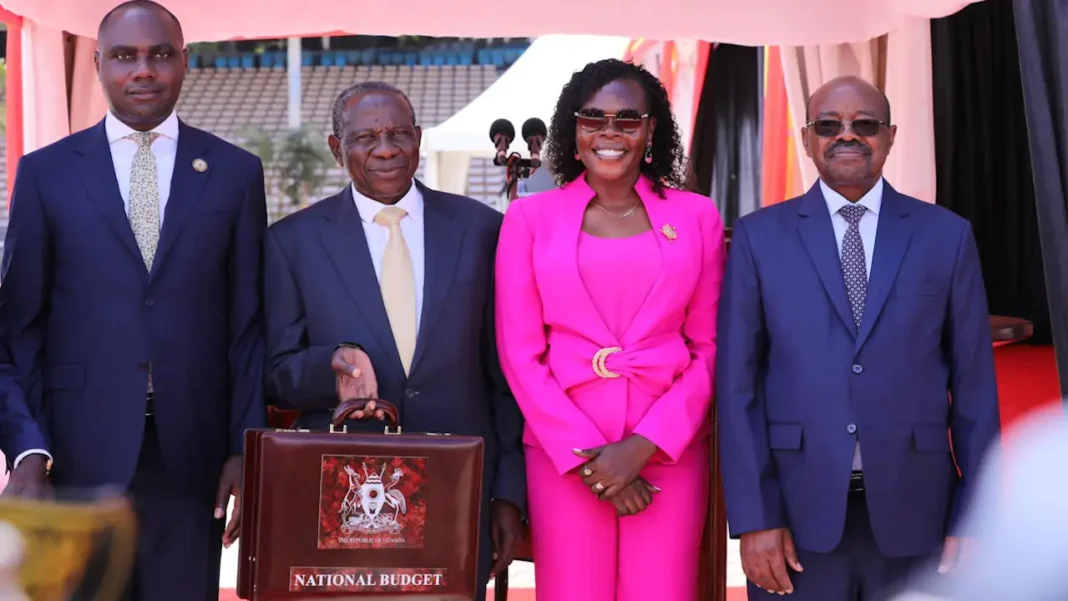
Uganda’s proposed national budget for the 2026/27 financial year, estimated at Shs84.2 trillion, has drawn sharp concern from taxpayers, economists, and political leaders over its sustainability and potential impact on the economy.
Presented to the ruling National Resistance Movement caucus, the spending plan outlines an ambitious fiscal path to be financed through a mix of domestic revenue, borrowing, and grants.
Government projects that Shs44 trillion will be raised from about 5.25 million registered taxpayers, though only around 20 percent are currently compliant.
The gap between projected revenue and actual collections has raised doubts about the feasibility of the plan, with authorities reportedly considering new tax measures, including a proposed fuel levy of Shs200 per litre.
Uganda’s public debt is now estimated at Shs126 trillion, equivalent to roughly Shs2.8 million per citizen. Economists caution that continued borrowing—particularly domestically, where debt stands at about Shs68.86 trillion—could crowd out private sector investment and slow economic activity.
Ibrahim Ssemujju Nganda, a member of parliament’s budget committee, warned that the current figures may not reflect the final cost of government spending, citing the likelihood of supplementary budgets.
“We haven’t concluded the budget, but what will it become after supplementary requests?” Ssemujju said. “Parliament must restrict government to the approved figures. We simply do not have the money to finance such a budget.”
He added that revenue projections appear overly optimistic, arguing that collections cannot realistically increase by more than Shs10 trillion within a single year.
He also highlighted the growing burden of debt servicing, noting that more than Shs13 trillion is spent annually on interest payments.
“We are heading toward a situation where nearly half of our revenue goes into servicing debt, not paying the principal. This compromises social service delivery,” he said.
Analyst Eddie Kwizera pointed to inconsistencies in the evolving budget figures, which rose from Shs78 trillion in the initial call circular to Shs80 trillion after policy statements, and now stand at Shs84.2 trillion.
“What should concern us is what is driving these changes—politics or economics?” Kwizera said. “If we cannot raise at least Shs20 trillion per quarter, this budget risks financing only recurrent expenditures like salaries, leaving little for development.”
Kwizera also criticised the continued use of tax waivers, arguing that they weaken revenue collection efforts.
Economist Julius Mukunda warned that the budget could expand further, potentially nearing Shs100 trillion after revisions. He questioned the sustainability of the government’s financing strategy, particularly its reliance on domestic borrowing and increased taxation.
“Taxing fuel is especially problematic because it affects the cost of living across the board,” Mukunda said. “The burden is falling on the same small group of compliant taxpayers.”
Mukunda noted that more than 24 percent of government revenue is already allocated to interest payments, describing the trend as unsustainable. He warned that increased domestic borrowing could restrict access to credit for businesses, further weakening economic growth.


